Chi uscì con Maria Ivanova Katatcharova?
Nicholas I of Russia ha datato Maria Ivanova Katatcharova dal ? al ?.
Alexander I of Russia ha datato Maria Ivanova Katatcharova dal ? al ?.
Maria Ivanova Katatcharova
Nicholas I of Russia
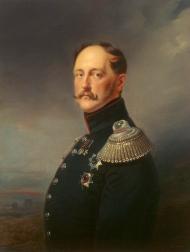
Nicholas I (6 July [O.S. 25 June] 1796 – 2 March [O.S. 18 February] 1855) was Emperor of Russia, King of Poland, and Grand Duke of Finland from 1825 to 1855. He was the third son of Paul I and younger brother of his predecessor, Alexander I. Nicholas's twenty nine-year reign began with the failed Decembrist revolt. He is mainly remembered as a reactionary whose controversial reign was marked by geographical expansion, centralisation of administrative policies, and repression of dissent both in Russia and among its neighbors. Nicholas had a happy marriage that produced a large family, with all of their seven children surviving childhood.
Nicholas's biographer Nicholas V. Riasanovsky said that he displayed determination, singleness of purpose, and an iron will, along with a powerful sense of duty and a dedication to very hard work. He saw himself as a soldier—a junior officer consumed by spit and polish. A handsome man, he was highly nervous and aggressive. Trained as a military engineer, he was a stickler for minute detail. In his public persona, stated Riasanovsky, "Nicholas I came to represent autocracy personified: infinitely majestic, determined and powerful, hard as stone, and relentless as fate."
Nicholas I was instrumental in helping to create an independent Greek state and resumed the Russian conquest of the Caucasus by seizing Iğdır Province and the remainder of modern-day Armenia and Azerbaijan from Qajar Iran during the Russo-Persian War (1826–1828). He ended the Russo-Turkish War (1828–1829) successfully as well. He crushed the November Uprising in Poland in 1831 and decisively aided Austria during the Hungarian Revolution of 1848. Later on, however, he led Russia into the Crimean War (1853–1856), with disastrous results. Historians emphasize that his micromanagement of the armies hindered his generals, as did his misguided strategy. Several historians have concluded that "the reign of Nicholas I was a catastrophic failure in both domestic and foreign policy." On the eve of his death, the Russian Empire spanned over 20 million square kilometers (7.7 million square miles), but had a desperate need for reform.
Per saperne di più...Maria Ivanova Katatcharova
Alexander I of Russia

Alessandro I di Russia (in russo Александр I Павлович Романов?, Aleksandr I Pavlovič Romanov; San Pietroburgo, 23 dicembre 1777 – Taganrog, 1º dicembre 1825), detto il Beato (in russo Благословенный?, Blagoslovennyj), fu imperatore di Russia dal 24 marzo 1801 fino alla morte.
Era il figlio primogenito dello zar Paolo I di Russia, figlio di Caterina II, e di Sofia Dorotea di Württemberg, figlia di Federico II Eugenio di Württemberg, che aveva assunto il nome di "Marija Fëdorovna" dopo la conversione alla fede cristiana ortodossa. Alessandro ascese al trono dopo una congiura in cui fu assassinato suo padre, a cui diede un riluttante assenso tentando di far risparmiare la vita del genitore. Sconfitto più di una volta da Napoleone Bonaparte, alla fine fu lui il vincitore definitivo sul lungo periodo, dopo aver sconfitto i francesi nella campagna di Russia insieme agli alleati della sesta coalizione, ed entrò per primo a Parigi pochi giorni prima dell'abdicazione dell'imperatore francese. Fu uno dei protagonisti del Congresso di Vienna e della Restaurazione, nonché fondatore della Santa Alleanza.
Dalla personalità ritenuta enigmatica e sfuggente, Alessandro fu, come la nonna paterna, un monarca illuminato, anche se periodicamente colto da crisi mistiche, dubbi e indecisioni, diviso tra il liberalismo giovanile e il conservatorismo reazionario degli ultimi anni. Anche le circostanze della sua morte non furono molto chiare all'epoca, e si diffuse la leggenda che egli l'avesse inscenata per dedicarsi alla vita religiosa.
Per saperne di più...