Chi uscì con Caterina II di Russia?
Alexander Yermolov ha datato Caterina II di Russia dal ? al ?.
Ivan Nikolaevič Rimskij-Korsakov ha datato Caterina II di Russia dal ? al ?. La differenza di età era di 24 anni, 8 mesi e 22 giorni.
Aleksandr Matveevič Dmitriev-Mamonov ha datato Caterina II di Russia dal ? al ?. La differenza di età era di 29 anni, 4 mesi e 28 giorni.
Aleksandr Dmitrievič Lanskoj ha datato Caterina II di Russia dal ? al ?. La differenza di età era di 28 anni, 10 mesi e 6 giorni.
Sergei Saltykov ha datato Caterina II di Russia dal ? al ?.
Pyotr Zavadovsky ha datato Caterina II di Russia dal ? al ?. La differenza di età era di 9 anni, 8 mesi e 19 giorni.
Semen Gavrilovič Zorič ha datato Caterina II di Russia dal ? al ?.
Alexander Vasilchikov ha datato Caterina II di Russia dal ? al ?.
Platon Zubov ha datato Caterina II di Russia dal ? al ?. La differenza di età era di 38 anni, 6 mesi e 24 giorni.
Grigorij Aleksandrovič Potëmkin ha datato Caterina II di Russia dal ? al ?. La differenza di età era di 10 anni, 4 mesi e 22 giorni.
Grigory Orlov ha datato Caterina II di Russia dal ? al ?. La differenza di età era di 5 anni, 5 mesi e 15 giorni.
Stanisław August Poniatowski ha datato Caterina II di Russia dal ? al ?. La differenza di età era di 2 anni, 8 mesi e 15 giorni.
Caterina II di Russia
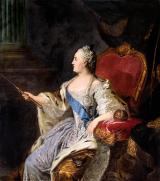
Caterina II di Russia (in russo Екатери́на II Алексе́евна?, Ekaterina II Alekseevna; Stettino, 2 maggio 1729 – San Pietroburgo, 17 novembre 1796) conosciuta come Caterina la Grande (in russo Екатери́на Вели́кая?, Ekaterína Velíkaja), fu imperatrice di Russia dal 1762 alla morte. Fu uno dei più significativi esempi di dispotismo illuminato.
Nata a Stettino come Sofia Augusta Federica di Anhalt-Zerbst (in tedesco Sophie Auguste Friederike von Anhalt-Zerbst), figlia del principe Cristiano Augusto, sovrano del Principato di Anhalt-Zerbst, venne data in sposa, sedicenne, all'erede al trono dell'Impero russo, il granduca Pietro Fëdorovič, futuro Pietro III di Russia. Con un colpo di Stato detronizzò il marito alla fine della guerra dei sette anni. Sotto il suo regno l'Impero russo accrebbe la sua potenza e visse uno dei periodi di maggior riconoscimento a livello europeo.
Volendo applicare al suo metodo di governo i principi illuministi, Caterina promosse la redazione di un nuovo codice ispirato alle idee degli enciclopedisti. Con i propri favoriti, in particolare Grigorij Orlov e a Grigorij Potëmkin, ma anche i generali di grande successo Pëtr Rumjancev e Aleksandr Suvorov, e ammiragli come Fëdor Ušakov, espanse rapidamente l'egemonia russa: a ovest approfittò dello smembramento della Confederazione polacco-lituana, occupando poi, in seguito alle guerre russo-turche, la Crimea; all'estremo est incominciò la colonizzazione dell'Alaska.
Ammiratrice di Pietro il Grande, Caterina continuò a modernizzare la Russia secondo le idee dell'assolutismo illuminato: si interessò ai problemi dell'istruzione, fondando il primo istituto di istruzione superiore femminile in Europa, delle finanze e della creazione di nuove cittadine fondate su suo ordine. Tuttavia la sua politica comportò un aumento del numero dei servi della gleba, con conseguente malcontento popolare e lo scoppio di numerose rivolte, represse violentemente, come quella guidata da Pugačëv.
Nonostante queste ambiguità politiche, grazie ai suoi rapporti epistolari e personali con vari filosofi illuministi quali Voltaire e Diderot, che ne elogiarono il governo, il periodo della dominazione di Caterina la Grande è considerato l'età d'oro dell'Impero russo. Fu sepolta nella cattedrale di San Pietro e Paolo a San Pietroburgo.
Per saperne di più...Alexander Yermolov
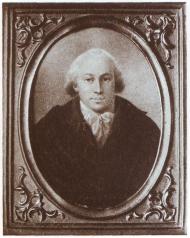
Alexander Petrovich Yermolov (1754–1834) was a Russian favourite and the lover of Catherine the Great from 1785 to 1786.
Yermolov was presented to Catherine by Grigory Potemkin, tested by Anna Protasova and became Catherine's lover in 1785. He collaborated with the enemies of Potemkin and attempted to have Potemkin removed, and thereby lost his position. He went to Paris in the late 1780s and spent the rest of his life in Schloss Frohsdorf.
Per saperne di più...Caterina II di Russia
Ivan Nikolaevič Rimskij-Korsakov

Il conte Ivan Nikolaevič Rimskij-Korsakov (in russo Иван Николаевич Римский-Корсаков?; San Pietroburgo, 29 giugno 1754 – San Pietroburgo, 31 luglio 1831) è stato un politico russo.
Per saperne di più...Caterina II di Russia
Aleksandr Matveevič Dmitriev-Mamonov

Il conte Aleksandr Matveevič Dmitriev-Mamonov (in russo Александр Матвеевич Дмитриев-Мамонов?; Smolensk, 30 settembre 1758 – San Pietroburgo, 11 ottobre 1803) è stato un diplomatico russo, appartenente ad un'antichissima dinastia della nobiltà dei boiardi discendente dei Rurichidi e con grandi possedimenti nei pressi di Smolensk.
In quanto aiutante di campo del conte Potemkin, Mamonov nel 1784 fu presentato alla zarina Caterina II, della quale in breve divenne il favorito.
Grazie al favore dell'imperatrice, che gli tributava 100.000 fiorini annui, riuscì ad istituire una piccola corte di illuministi, che tra gli altri comprendeva il conte Semën Romanovič Voroncov, Nikolaj Aleksandrovič Zubov, fratello di Platon Aleksandrovič Zubov, Pëtr Alekseevič Palen, José de Ribas, Aleksandr Andreevič Bezborodko e Nikita Petrovič Panin e inoltre Mamonov tenne un frequente scambio epistolare con il mecenate di Wolfgang Amadeus Mozart, Friedrich Melchior von Grimm.
Nel 1787 prese parte ai negoziati con Stanislao II Augusto Poniatowski e Giuseppe II d'Austria, divenendo Reichsgraf ("conte del Sacro romano impero"). Alla sua morte fu inumato nel Monastero di Donskoj.
Per saperne di più...Caterina II di Russia
Aleksandr Dmitrievič Lanskoj
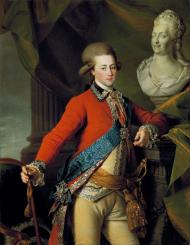
Conte Aleksandr Dmitrievič Lanskoj (in russo Александр Дмитриевич Ланской?; Tallinn, 10 agosto 1758 – San Pietroburgo, 11 dicembre 1784) è stato un militare russo.
Per saperne di più...Caterina II di Russia
Sergei Saltykov

Sergej Vasil'evič Saltykov (in russo Сергей Васильевич Салтыков?; Mosca, 1726 – San Pietroburgo, 1765) fu uno statista russo, favorito dell'imperatrice Caterina II.
Per saperne di più...Caterina II di Russia
Pyotr Zavadovsky
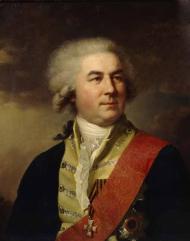
Peter Vasiljevitj Zavadovskij (ryska: Пётр Васильевич Завадовский), född 10 januari 1739, död 10 januari 1812, var en rysk greve och gunstling till Katarina den stora.
Zavadovskij blev 1775 Katarinas sekreterare och blev den 2 januari 1776 hennes generaladjutant och älskare. Han beskrivs som stilig, kultiverad och allvarlig samt anses ha varit uppriktigt förälskad i Katarina. Förhållandet var ansträngt på grund av den svartsjuka han kände mot Potemkin, vars nära relation med Katarina fortgick trots att han i egenskap av älskare hade ersatt honom; även Potemkin ryktas ha haft åtminstone ett vredesutbrott på grund av relationen. Förhållandet avslutades på grund av de ständiga slitningarna och han ersattes 1777 av Simon Zoritj. Då relationen med Zoritj avslutades 1778 ska Katarina ha övervägt att återkalla Zavadovksij, men hon mötte då i stället Ivan Rimskij-Korsakov.
Per saperne di più...Caterina II di Russia
Semen Gavrilovič Zorič

Count Semyon Zorich (1743–1799) was a Serbian-born Russian lieutenant-general and count of the Holy Roman Empire. He served Russia against the Prussians and Turks. A member of the Russian court, he was presented to Empress Catherine the Great by Grigory Potemkin and, after having been tested by Praskovja Bruce and doctor Rogerson, became the Empress' lover. He was most influential in the commercial development of Shklov and Mogilev.
Per saperne di più...Caterina II di Russia
Alexander Vasilchikov

Aleksandr Semënovič Vasil'čikov (in russo Александр Семёнович Васильчиков?; Mosca, 1744 – Mosca, 1813) fu uno dei favoriti dell'imperatrice Caterina II dal 1772 al 1774.
Per saperne di più...Caterina II di Russia
Platon Zubov
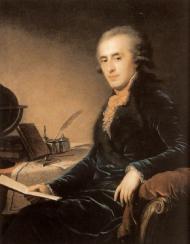
Il principe Platon Aleksandrovič Zubov (in russo Платон Александрович Зубов?; San Pietroburgo, 15 novembre 1767 – Varsavia, 7 aprile 1827) è stato un politico russo.
Per saperne di più...Caterina II di Russia
Grigorij Aleksandrovič Potëmkin
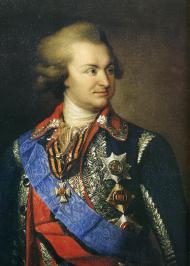
Prince Grigory Aleksandrovich Potemkin-Tauricheski (11 October [O.S. 30 September] 1739 – 16 October [O.S. 5 October] 1791) was a Russian military leader, statesman, nobleman, and favourite of Catherine the Great. He died during negotiations over the Treaty of Iași, which ended a war with the Ottoman Empire that he had overseen.
Potemkin was born into a family of middle-income landowners of Russian nobility. He first attracted Catherine's favor for helping in her 1762 coup, then distinguished himself as a military commander in the Russo-Turkish War (1768–1774). He became Catherine's lover, favorite and possibly her consort. After their passion cooled, he remained her lifelong friend and favored statesman. Catherine obtained for him the title of Prince of the Holy Roman Empire and gave him the title of Prince of the Russian Empire among many others: he was both a Grand Admiral and the head of all of Russia's land and irregular forces. Potemkin's achievements include the peaceful annexation of the Crimea (1783) and the successful second Russo-Turkish War (1787–1792), during which the armed forces under his command besieged Ochakov.
In 1775, Potemkin became the governor-general of Russia's new southern provinces. An absolute ruler, he worked to colonize the wild steppes, controversially dealing firmly with the Cossacks who lived there. He founded the towns of Kherson, Nikolayev, Sevastopol, and Yekaterinoslav. Ports in the region became bases for his new Black Sea Fleet.
His rule in the south is associated with the (probably mythical) "Potemkin village", a ruse involving the construction of painted façades to mimic real villages, full of happy, well-fed people, for visiting officials to see. Potemkin was known for his love of women, gambling and material wealth. He oversaw the construction of many historically significant buildings, including the Tauride Palace in Saint Petersburg.
Per saperne di più...Caterina II di Russia
Grigory Orlov
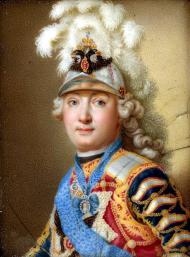
Prince Grigory Grigoryevich Orlov (Russian: Григорий Григорьевич Орлов; 17 October 1734 – 24 April 1783) was a Russian general and patron of arts who was Prince of the Holy Roman Empire (1772) and a favourite of Empress Catherine the Great. He was a leader of the 1762 coup which overthrew Catherine's husband Peter III and installed Catherine as reigning empress. For some years he was virtually co-ruler with her, but his repeated infidelities and the enmity of Catherine's other advisers led to his fall from power.
He patronised M. V. Lomonosov, D. I. Fonvisin, V. I. Bazhenov and gave them financial support. Honorary member of the Imperial Academy of Arts (since 1765). He collected paintings (including Rembrandt, P. P. Rubens, Titian), sculpture, Chinese, Japanese and Russian porcelain, hunting weapons, etc. (Orlov's collection has been preserved almost completely; it is now in the State Museum-Reserve "Gatchina" of the eponymous city). A large landowner, Orlov commissioned the construction of the Great Gatchina Palace.
Per saperne di più...Caterina II di Russia
Stanisław August Poniatowski
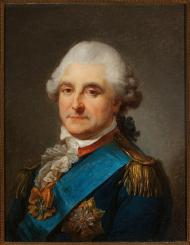
Stanislas II (en polonais : Stanisław August), de son vrai nom Stanisław Antoni Poniatowski, né le à Wołczyn (actuelle Biélorussie) et mort le à Saint-Pétersbourg, est, de 1764 à 1795, le dernier roi de Pologne et grand-duc de Lituanie, à l'époque de la République des Deux Nations.
Selon la titulature officielle, il est « par la grâce de Dieu et la volonté du peuple, roi de Pologne, grand-duc de Lituanie et duc de Ruthénie, Prusse, Mazovie, Samogitie, Kiev, Volhynie, Podolie, Podlasie, Livonie, Smolensk, Siewierz et Czernihów. »
Son règne a connu bien des vicissitudes. En 1762, son ancienne maîtresse, la princesse russe d'origine allemande Catherine, née Sophie Frédérique Augusta d'Anhalt-Zerbst, devient impératrice de Russie sous le nom de Catherine II. En 1764, après la mort d'Auguste III, Poniatowski est élu roi de Pologne en tant que candidat de la Russie et de la famille Czartoryski, qui est favorable à l'alliance étroite de la Pologne avec la Russie. Celle-ci, secondée par la Prusse, joue un rôle important au début du règne de Stanislas II, par le biais de son ambassadeur à Varsovie Nicolas Repnine.
La révolte d'une partie de la noblesse hostile à la Russie, liguée dans la confédération de Bar (1768-1772), aboutit au premier partage de la Pologne (1772). Stanislas II, maintenu sur le trône du fait de la défaite des confédérés, s'efforce alors de promouvoir un certain nombre de réformes, dont on peut citer la création de la Commission de l'Éducation nationale (1773), dans la limite de ce que son protecteur russe peut accepter.
Mais à la fin des années 1780, le mouvement de réforme prend une telle ampleur, à l'époque de la Grande Diète (1788-1792), qu'elle suscite l'hostilité de la Russie, dirigée par Catherine II jusqu'en 1796 : la promulgation de la Constitution du , la première en Europe, est l'origine directe de la guerre russo-polonaise de 1792, dont la suite est le deuxième partage de la Pologne (1793) et la soumission de Stanislas au parti pro-russe de la confédération de Targowica. En 1794, Stanislas apporte toutefois un certain soutien à l'insurrection dirigée par Tadeusz Kościuszko contre la Russie. Sa défaite aboutit au troisième partage de la Pologne en 1795 : privée de la totalité de son territoire, la république des Deux Nations cesse d'exister et Stanislas est contraint d'abdiquer, pour aller finir sa vie à Saint-Pétersbourg, au début du règne de Paul Ier.
Per saperne di più...