Chi uscì con Mary Robinson (poetessa)?
George Capel-Coningsby, 5th Earl of Essex ha datato Mary Robinson (poetessa) dal ? al ?. La differenza di età era di 1 anni, 0 mesi e 14 giorni.
Banastre Tarleton ha datato Mary Robinson (poetessa) dal ? al ?. La differenza di età era di 4 anni, 3 mesi e 6 giorni.
Charles James Fox ha datato Mary Robinson (poetessa) dal ? al ?. La differenza di età era di 9 anni, 10 mesi e 3 giorni.
George IV of the United Kingdom ha datato Mary Robinson (poetessa) dal ? al ?. La differenza di età era di 3 anni, 8 mesi e 16 giorni.
Mary Robinson (poetessa)

Mary Robinson (Bristol, 27 novembre 1757 – 26 dicembre 1800) è stata una poetessa inglese, amante di Giorgio IV.
Per saperne di più...George Capel-Coningsby, 5th Earl of Essex

George Capel-Coningsby, 5th Earl of Essex FSA (13 November 1757 – 23 April 1839) was an English aristocrat and politician, and styled Viscount Malden until 1799. His surname was Capell until 1781.
Per saperne di più...Mary Robinson (poetessa)
Banastre Tarleton

General Sir Banastre Tarleton, 1st Baronet, (21 August 1754 – 15 January 1833) was a British military officer and politician. He was the leader of the British Legion during the southern campaign of the American War of Independence.
After promotion to lieutenant colonel, he later served in Portugal and held commands in Ireland and England, eventually reaching the rank of General in his later years.
After returning to Great Britain in 1781, Tarleton was elected to Parliament as a member for Liverpool. He served as a prominent Whig politician for 20 years.
Per saperne di più...Mary Robinson (poetessa)
Charles James Fox

Charles James Fox (24 January 1749 – 13 September 1806), styled The Honourable from 1762, was an English Whig politician and statesman whose parliamentary career spanned 38 years of the late 18th and early 19th centuries. He was the arch-rival of the Tory politician William Pitt the Younger; his father Henry Fox, 1st Baron Holland, a leading Whig of his day, had similarly been the great rival of Pitt's famous father, William Pitt, 1st Earl of Chatham ("Pitt the Elder").
Fox rose to prominence in the House of Commons as a forceful and eloquent speaker with a notorious and colourful private life, though at that time with rather conservative and conventional opinions. However, with the coming of the American War of Independence and the influence of the Whig Edmund Burke, Fox's opinions evolved into some of the most radical to be aired in the British Parliament of his era.
Fox became a prominent and staunch opponent of King George III, whom he regarded as an aspiring tyrant. He supported the American Patriots and even dressed in the colours of George Washington's army. Briefly serving as Britain's first Foreign Secretary during the ministry of the Marquess of Rockingham in 1782, he returned to the post in a coalition government with his old enemy, Lord North, in 1783. However, the King forced Fox and North out of government before the end of the year and replaced them with the 24-year-old Pitt the Younger. Fox spent the following 22 years facing Pitt and the government from the opposition benches of the House of Commons.
Though Fox had little interest in the actual exercise of power and spent almost the entirety of his political career in opposition, he became noted as an anti-slavery campaigner, a supporter of the French Revolution and a leading parliamentary advocate of religious tolerance and individual liberty. His friendship with his mentor, Burke, and his parliamentary credibility were both casualties of Fox's support for France during the French Revolutionary Wars, but Fox went on to attack Pitt's wartime legislation and to defend the liberty of religious minorities and political radicals. After Pitt's death in January 1806, Fox served briefly as Foreign Secretary in the 'Ministry of All the Talents' of William Grenville before he died on 13 September 1806, aged 57.
Per saperne di più...Mary Robinson (poetessa)
George IV of the United Kingdom
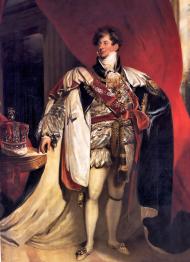
Giorgio IV di Hannover (Giorgio Augusto Federico di Hannover; Londra, 12 agosto 1762 – Windsor, 26 giugno 1830) è stato re del Regno Unito di Gran Bretagna e Irlanda e re di Hannover dal 29 gennaio 1820 al 26 giugno 1830. Figlio primogenito di Giorgio III e di Carlotta di Meclemburgo-Strelitz, aveva precedentemente esercitato le funzioni di principe reggente a causa dell'infermità mentale del padre.
Giorgio era un monarca ostinato, che spesso intervenne di persona negli affari politici, soprattutto riguardo alla questione dell'emancipazione cattolica che, seppur riluttante, dovette infine accettare, ma lo fu in misura molto inferiore rispetto al padre. Per la maggior parte della sua reggenza e del suo regno fu lord Liverpool, il Primo Ministro, ad avere il governo effettivo del regno.
Gli anni della Reggenza di Giorgio IV (1811-1820) furono segnati dalla vittoria nelle guerre napoleoniche in Europa e da un clima culturale particolarmente vivace in patria, favorito dalla Pax Britannica.
Durante il suo regno vennero abrogati i Combination Act che proibivano la libera associazione dei lavoratori. Nel 1829, sotto il suo regno, sir Robert Peel creò la Metropolitan Police Service, i cui componenti sono più noti come bobby.
Giorgio IV è spesso ricordato come un principe e re liberale e stravagante: per questo si guadagnò l'appellativo di First Gentleman. Ebbe pessimi rapporti tanto con il padre che con la moglie, Carolina di Brunswick, dalla quale tentò di separarsi senza successo con il Pains and Penalties Bill 1820. Fu patrono delle arti, dell'architettura (affidò a John Nash la costruzione del Royal Pavilion di Brighton e il rifacimento di Buckingham Palace e a Jeffry Wyatville la ricostruzione del castello di Windsor) e della letteratura, vivendo un'intensa vita mondana che lo portò a legarsi ai dandy più alla moda di Londra, contribuendo così al fascino del periodo Regency.
La sua unica figlia legittima, la principessa Carlotta, gli premorì nel 1817 e, pertanto, egli venne succeduto da suo fratello minore, Guglielmo IV.
Per saperne di più...